A car maintenance schedule keeps you from forgetting anything: some jobs are due by mileage, others by date, and most by whichever comes first. This guide gives common ranges, explains how periodic inspection works in France as a worked example, and shows how to turn it all into car maintenance reminders in LoggyCar.
The figures below are indicative. Your manufacturer's service booklet always comes first, because it depends on the engine, the gearbox and how you drive.
Mileage or date: both count
A car that rarely moves still ages: the oil oxidizes, brake fluid absorbs moisture and tire rubber hardens. A high-mileage driver, on the other hand, reaches the distance limit long before the date. The rule is simple: act on whichever limit comes first. For oil change detail (petrol, diesel, city driving) read our complete oil change guide; here it is just one line of the overall schedule.
Common intervals at a glance
| Job | By distance (common range) | By time |
|---|---|---|
| Engine oil and oil filter | 6,000 to 18,000 miles depending on engine and oil | 1 to 2 years |
| Air, cabin and fuel filters | 9,000 to 18,000 miles | 1 to 2 years |
| Brake fluid | rarely by distance | about every 2 years |
| Brake pads and discs | check at every service; wear varies widely | yearly check |
| Timing belt | 40,000 to 150,000 miles depending on engine | 5 to 10 years |
| Tires | 18,000 to 30,000 miles depending on axle and driving | watch ageing after 5 to 6 years |
| Battery | no distance limit | often 4 to 6 years |
| Spark plugs (petrol) | 18,000 to 36,000 miles | 2 to 4 years |
| Periodic inspection (France) | no distance limit | before 4 years, then every 2 years |
The ranges are wide on purpose: a recent engine with long-life oil does not need what an older one does. For tires, pressure matters as much as age: the U.S. Department of Energy notes that the right pressure is on the sticker in the driver's door jamb or in the owner's manual, not the maximum printed on the sidewall [2].
Worked example: periodic inspection in France
Inspection rules differ from country to country, so check your local authority. In France, the official Service-Public page for cars says [1]:
- the first inspection is due in the 6 months before the 4th anniversary of first registration;
- after that, a pass is valid for 2 years, so the inspection is repeated every 2 years;
- after a failed inspection, the re-inspection must take place within 2 months;
- a critical defect (direct and immediate danger) limits the validity of the inspection to that very day;
- driving without a valid inspection can lead to a fine of up to 750 euros, usually a fixed fine of 135 euros.
Take a car first registered on 15 March 2023 and driven 15,000 km (about 9,300 miles) a year. Its 4th anniversary is 15 March 2027, so the first inspection window opens on 15 September 2026 and closes on 15 March 2027. If it passes on 20 November 2026, the next one is due before 20 November 2028.
For oil, suppose a change on 10 September 2026 at 52,500 km, with an interval of 15,000 km or 12 months. At 15,000 km a year both limits arrive together: next change around 10 September 2027, near 67,500 km. A driver doing only 8,000 km a year would reach the date long before the distance, and the date would win.
Setting up car maintenance reminders in LoggyCar
In LoggyCar a reminder can trigger by mileage, by date, or both. Here is what the app offers:
- Open the vehicle's "Maintenance & reminders" screen and tap "+ Reminder". A vehicle without reminders also offers "Enable the 4 essential reminders" (oil change, insurance, inspection, road tax).
- Pick a quick template: oil change, technical inspection, timing belt, brakes and pads, tires, spark plugs, filters, insurance, road tax.
- Adjust "Every … km" and "Every … months". The templates start at, for example, 10,000 km and 12 months for the oil change, 80,000 km and 60 months for the timing belt, 30,000 km and 24 months for brakes. These are starting values to match to your booklet.
- For a fixed-date document such as the inspection, fill in "Next due date" with the real date. The template proposes 12 months: for an inspection every 2 years, enter 24 in "Every … months".
- Choose "Notify me": on the day, or 7, 15 or 30 days before. The default is 30 days for documents (insurance, inspection, road tax) and 7 days for everything else.
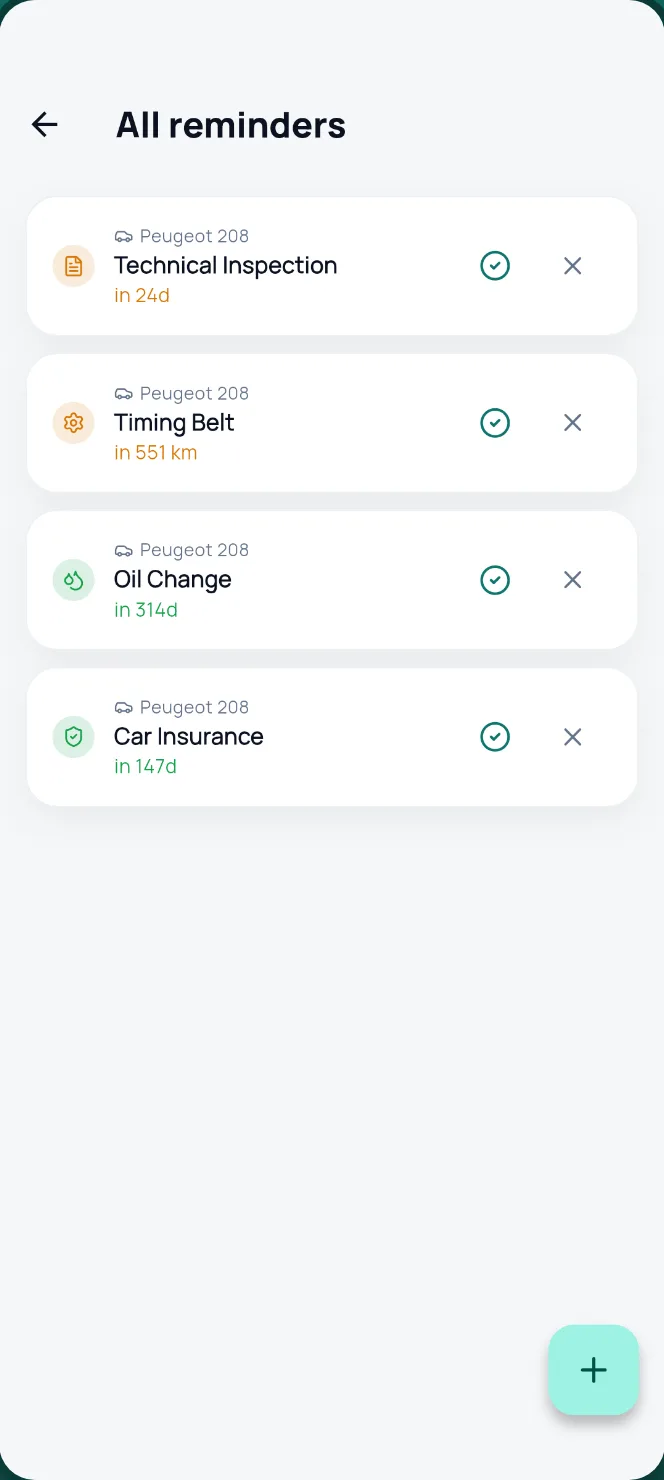
The app then alerts you at 9 a.m. at the chosen notice, 7 days and the day before when the notice allows, on the due date, and follows up 3 and 7 days later if the reminder is not marked as done. For a mileage reminder, LoggyCar estimates the date you will reach the limit from the pace of your odometer readings over the last 90 days, and alerts you when that estimated date falls within your notice period, provided you have a reading from the last 30 days. The more readings you enter, the more useful the estimate. The full list is under "All reminders".
The features page covers the maintenance log in more detail, and the download page gets the app on your phone in a few minutes.
The habit that pays off
Record the date and mileage of every job in one place, compare with your manufacturer's booklet, then let the reminders do the work. Small regular maintenance almost always costs less than a repair you did not see coming.